7.1.3 PRED_LANDING Model
Purpose
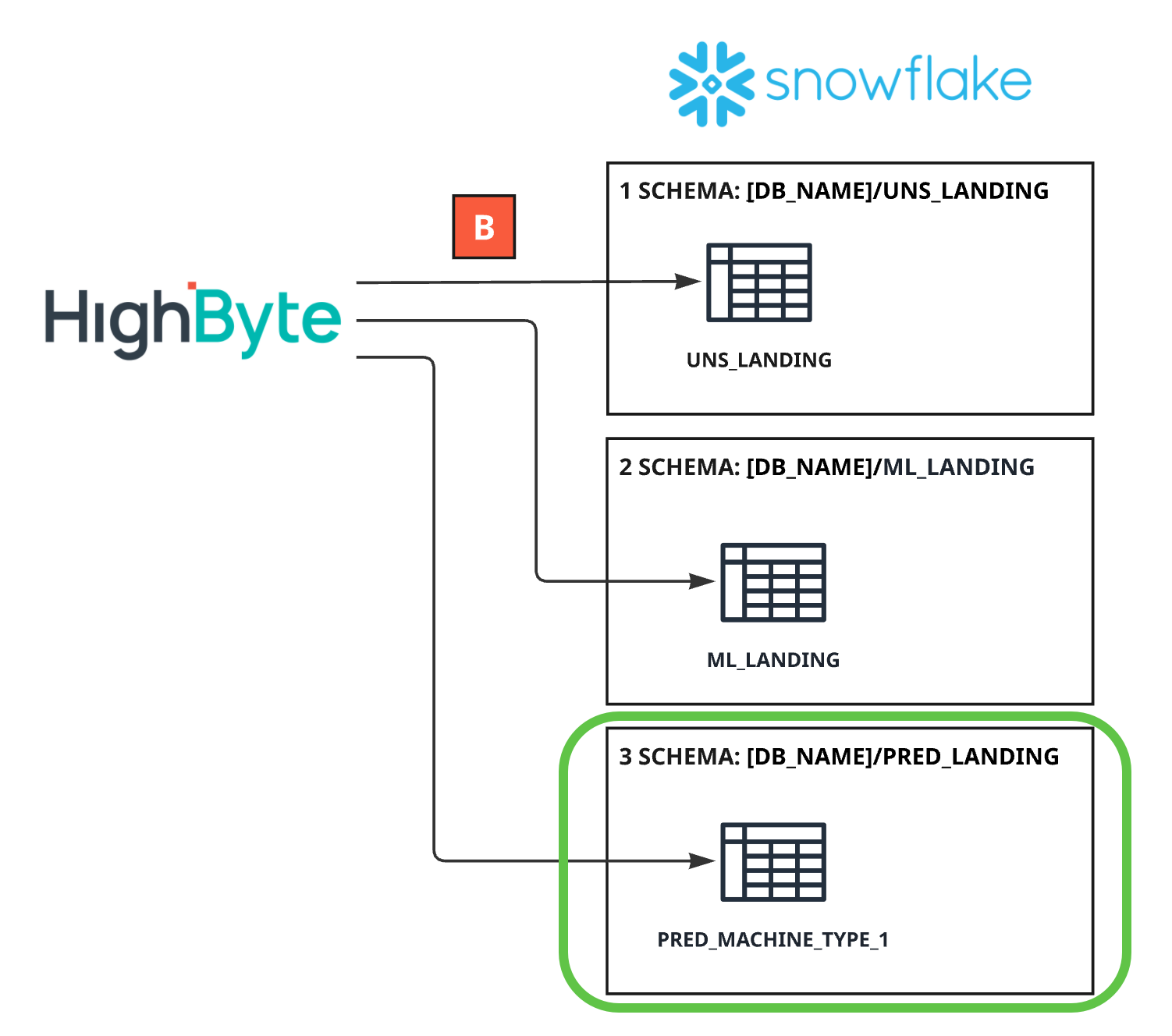
The PRED_LANDING schema represents the inference result event layer within the Snowflake serving model.
Its role is to store contextualised, versioned prediction outputs generated by the production inference pipeline (Pipeline J).
This layer enables:
Historical monitoring of model behaviour
Model performance evaluation
Feedback loops for retraining
Auditability of inference decisions
PRED_LANDING mirrors the payload-centric architecture used in UNS_LANDING and ML_LANDING to ensure structural consistency across the ML lifecycle.
Design Intent
The PRED_LANDING model is designed around the following principles:
1. Inference Event Representation
Each record represents one inference event aligned to a specific feature evaluation timestamp. Predictions are stored as structured event payloads rather than wide, rigid column tables.
2. Full Lineage & Reproducibility
Each inference record preserves:
MODEL_NAME
MODEL_VERSION
FEATURE_VERSION
This ensures deterministic traceability between:
Feature dataset (ML_LANDING)
Model artifact
Prediction outcome
3. Structural Symmetry
PRED_LANDING follows the same event-based, payload-centric structure as:
UNS_LANDING (contextualized OT events)
ML_LANDING (feature events)
This enables architectural consistency and simplified governance.
4. Separation from Operational Systems
PRED_LANDING is not used for real-time control or SCADA decision logic. Real-time actions occur via MQTT distribution. PRED_LANDING is the historical and analytical persistence layer for inference outcomes.
Data Grain & Structure
Grain
1 row per asset per inference evaluation event. Each record corresponds to a single feature evaluation point.
Core Identifiers
EVENT_TS – timestamp representing the feature evaluation time
ASSET_PATH – unique asset identifier
ISA-95 routing context (SITE_ID, AREA_ID, LINE_ID, CELL_ID)
MACHINE_TYPE
MODEL_OBJECTIVE
MODEL_NAME
MODEL_VERSION
FEATURE_VERSION
Payload-Centric Storage Model
PRED_LANDING uses a single structured payload to store inference outputs.
Example conceptual structure:
CREATE OR REPLACE TABLE TMA_APPOMAX_DB.PRED_LANDING.INFERENCE_EVENTS (
    EVENT_TS        TIMESTAMP_NTZ(9),
    SITE_ID         VARCHAR,
    AREA_ID         VARCHAR,
    LINE_ID         VARCHAR,
    CELL_ID         VARCHAR,
    ASSET_PATH      VARCHAR,
    MACHINE_TYPE    VARCHAR,
    MODEL_OBJECTIVE VARCHAR,
    MODEL_NAME      VARCHAR,
    MODEL_VERSION   VARCHAR,
    QUALITY         VARCHAR,
    PAYLOAD         VARIANT
);
NOTE:
The PAYLOAD column contains structured inference output, such as:
{
  "prediction": 1,
  "score": 0.87,
  "decision": "ANOMALY",
  "threshold": 0.75,
  "confidence": 0.91,
  "feature_reference": {
    "event_ts": "2026-02-06T10:01:00Z",
    "feature_version": "v3.2"
  }
}
This structure:
Allows flexible evolution of the output schema
Avoids rigid DDL changes
Supports additional metrics (e.g., SHAP values, probability vectors)
Maintains compatibility across model versions
Example Data: PRED_LANDING
Lineage & Traceability
To ensure reproducibility and auditability:
MODEL_VERSION identifies the deployed model artifact
FEATURE_VERSION identifies the feature logic used
EVENT_TS links back to the corresponding ML_LANDING feature event
This enables:
Model performance analysis
Post-hoc validation
Root-cause analysis
Retraining workflows
Usage Pattern
PRED_LANDING is used for:
Model performance monitoring
Drift detection
Retraining dataset assembly
KPI tracking (e.g., precision, recall, defect detection rate)
Enterprise reporting on predictive initiatives
It is not intended for:
Operational HMI consumption
Real-time control logic
Direct MES integration
Relationship to Other Models
Upstream:
Receives inference-aligned feature events derived from ML_LANDING
Downstream:
Feeds enterprise analytics and ML monitoring workflows
Supports feedback loops for feature and model improvement
PRED_LANDING completes the closed-loop architecture:
Contextualised OT Events → Feature Events → Inference Events → Model Improvement
Summary
The PRED_LANDING model provides:
Versioned
Contextualized
Payload-centric
Reproducible inference event records
It ensures architectural consistency across the ML lifecycle while maintaining flexibility for evolving model outputs and analytical requirements.