7.1.2 ML_LANDING Model
Purpose
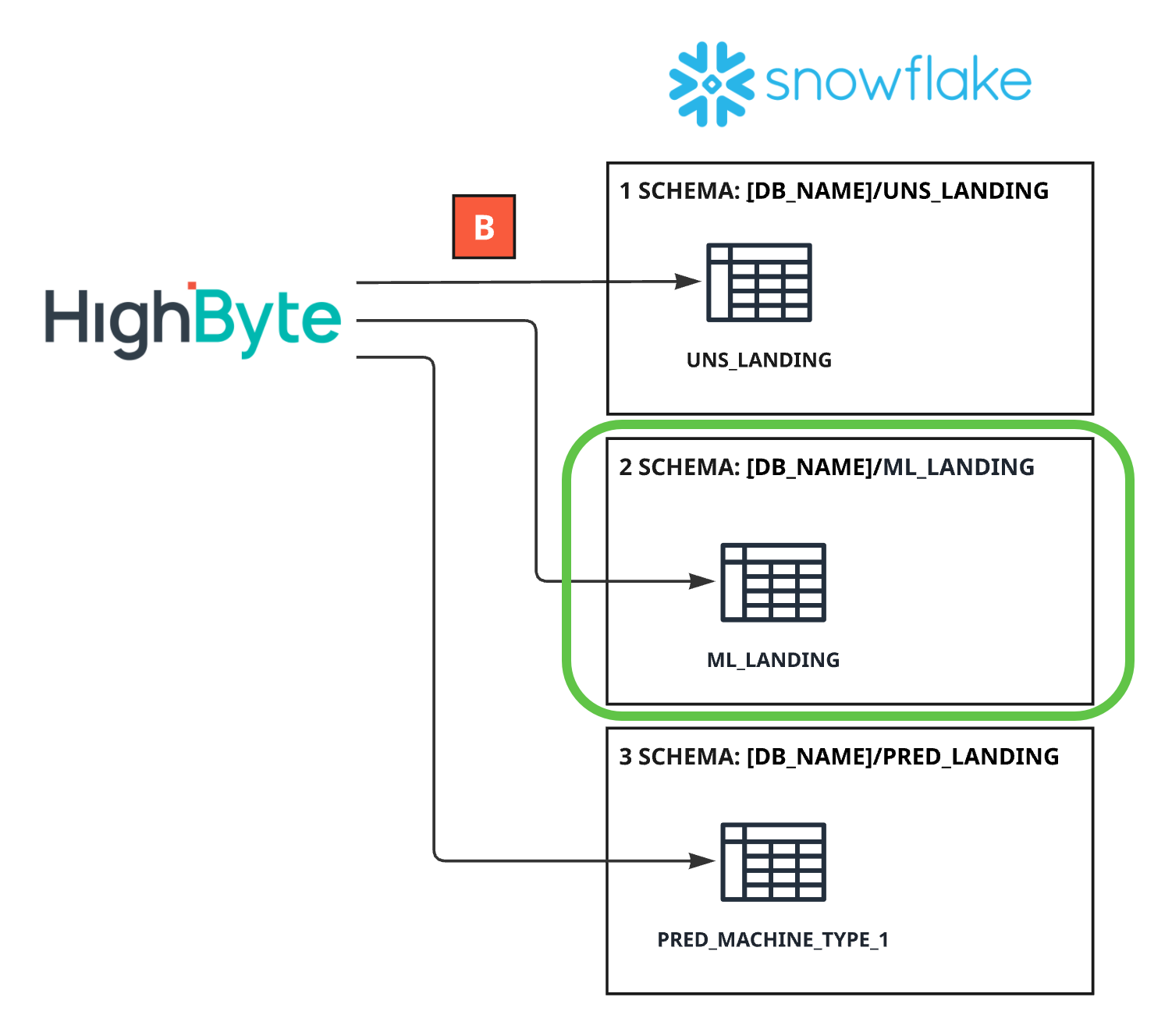
The ML_LANDING schema represents the inference-aligned feature event layer within the Snowflake serving model.
Its role is to materialise feature-engineered datasets that strictly follow a defined Feature Contract, ensuring alignment between:
Model training
Validation workflows
Production inference logic
Unlike UNS_LANDING, which supports exploratory analysis and experimentation, ML_LANDING is a structured, governed dataset intended to match the feature format required by inference objectives.
Design Intent
1. Feature Contract–Driven
All records conform to a deterministic and versioned Feature Contract. Feature definitions, statistical calculations, ratios, and transformations are governed upstream and materialised in this layer without further reinterpretation. Any change to feature logic results in a new FEATURE_VERSION.
2. Inference Alignment
The feature structure stored in ML_LANDING mirrors the structure required by the production inference pipeline. Training datasets are assembled from ML_LANDING to guarantee structural consistency between:
Offline model development
Online scoring
3. Objective / Type Segmentation
Feature payloads may differ across:
Machine types
Asset classes
Inference objectives
Rather than forcing a universal schema, ML_LANDING supports logical separation by:
MACHINE_TYPE
MODEL_OBJECTIVE
FEATURE_VERSION
This prevents cross-contamination of feature definitions.
4. Separation from Experimental Data
ML_LANDING is not a general exploration layer. Data science experimentation, ad hoc feature discovery, and raw signal analysis occur using UNS_LANDING. ML_LANDING only contains feature sets that are approved, versioned, and aligned with inference requirements.
Data Grain & Structure
Grain
1 row per asset per inference evaluation event.
Each record represents a feature event aligned to a defined evaluation timestamp.
Core Identifiers
EVENT_TS – timestamp representing the feature evaluation point
ASSET_PATH – unique asset identifier
ISA-95 routing context (SITE_ID, AREA_ID, LINE_ID, CELL_ID)
MACHINE_TYPE
MODEL_OBJECTIVE
FEATURE_VERSION
Payload-Centric Storage Model
ML_LANDING follows the same payload-centric design as UNS_LANDING. Instead of wide exploded feature columns, all feature values are stored within a single structured payload.
Example conceptual structure:
CREATE OR REPLACE TABLE TMA_APPOMAX_DB.ML_LANDING.FEATURE_EVENTS (
    EVENT_TS        TIMESTAMP_NTZ(9),
    SITE_ID         VARCHAR,
    AREA_ID         VARCHAR,
    LINE_ID         VARCHAR,
    CELL_ID         VARCHAR,
    ASSET_PATH      VARCHAR,
    MACHINE_TYPE    VARCHAR,
    MODEL_OBJECTIVE VARCHAR,
    FEATURE_VERSION VARCHAR,
    PAYLOAD         VARIANT
);
The PAYLOAD column contains a structured JSON object, such as:
{
  "state_features": {
    "is_running": true,
    "error_count": 2
  },
  "statistical_features": {
    "avg_joint_speed": 12.4,
    "std_motor_current": 0.87
  },
  "ratio_features": {
    "motor_power_on_ratio": 0.92
  },
  "label": {
    "defect": 0,
    "horizon_min": 10
  }
}
This structure:
Enables flexible feature evolution
Avoids rigid schema changes
Preserves inference contract integrity
Supports future feature expansion without DDL modifications
NOTE: Only one ML_LANDING table for all types of machines.
Example Data: ML_LANDING
Feature Governance & Versioning
To ensure reproducibility:
FEATURE_VERSION is mandatory
Any change in:
Aggregation logic
Statistical method
Ratio definition
Feature inclusion/exclusion
results in a new version
This enables:
Historical retraining
A/B model comparison
Drift analysis
Safe feature evolution
Usage Pattern
ML_LANDING is used for:
Model training
Validation
Batch scoring
Feature drift monitoring
Explainability workflows
It is not intended for:
Operational dashboards
Direct BI reporting
Raw signal exploration
Relationship to Other Models
Upstream:
Derived exclusively from UNS_LANDING using governed transformation logic
Downstream:
Consumed by Pipeline J (On-Prem Inference)
Feeds PRED_LANDING for inference result storage
ML_LANDING represents the controlled contract between contextualised OT data and production ML systems.
Summary
The ML_LANDING model provides:
Versioned
Objective-specific
Inference-aligned
Payload-centric feature event datasets
This ensures architectural consistency across training, validation, and production inference while preserving flexibility and governance.