7.1.1 UNS_LANDING Model
Purpose
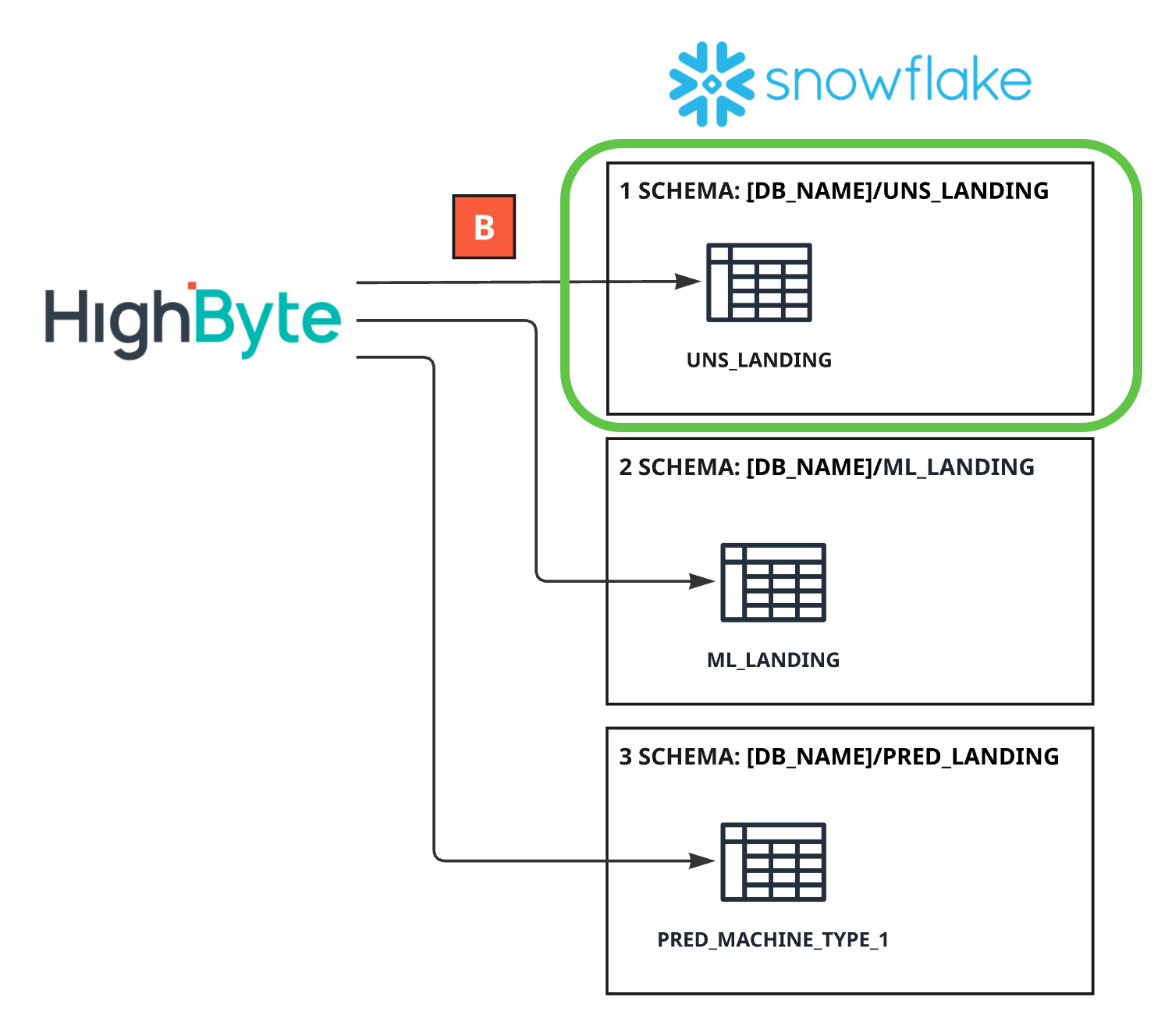
The UNS_LANDING schema represents the raw, historical landing zone for contextualised OT data published by HighByte into Snowflake.
Its role is to serve as the immutable, replayable source of truth for all downstream analytics, feature engineering, and ML workflows, while preserving maximum fidelity from the source systems.
This schema intentionally prioritises traceability, flexibility, and governance over query convenience.
Design Intent
The UNS_LANDING model is designed around the following principles:
Minimal transformation at ingest
Data is landed in Snowflake with only essential routing and governance metadata applied.
No feature engineering or aggregation occurs at this stage.
Payload-centric storage
Each row represents a single UNS payload/event, which may contain multiple tags or signals.
This avoids exploding high-frequency data into tag-level rows prematurely.
Schema evolution by design
Raw payloads are stored as semi-structured data to accommodate:
Changes in machine configuration
New signals or attributes
Payload versioning over time
Data Grain & Structure
Grain:
1 row per UNS payload/event
Key characteristics:
A payload may represent:
A batch of high-frequency data
An event-based update
A contextualised asset snapshot
The payload structure is defined and governed upstream (HighByte), not by the Snowflake table schema
Routing & Context Columns
To ensure enterprise usability and lineage, each record includes fixed metadata columns that define where the data came from and what it represents:
create or replace TABLE TMA_APPOMAX_DB.UNS_LANDING.UNS_LANDING (
	EVENT_TS TIMESTAMP_NTZ(9),
	SITE_ID VARCHAR(16777216),
	AREA_ID VARCHAR(16777216),
	LINE_ID VARCHAR(16777216),
	CELL_ID VARCHAR(16777216),
	ASSET_PATH VARCHAR(16777216),
	SOURCE_SYSTEM VARCHAR(16777216),
	MACHINE_TYPE VARCHAR(16777216),
	QUALITY VARCHAR(16777216),
	PAYLOAD VARIANT
)COMMENT='HighByte UNS landing table (multi-tag payload). 1 row per payload/event.'
;
ISA-95 routing context
SITE_ID
AREA_ID
LINE_ID
CELL_ID
ASSET_PATH
Source & contract metadata
SOURCE_SYSTEM (e.g. HighByte, Ignition)
MACHINE_TYPE (payload schema/contract identifier)
These fields enable:
Cross-site filtering
Asset-level lineage
Deterministic downstream joins without inspecting the payload body
Example Data: UNS_LANDING
Time Semantics
EVENT_TS
The original event or measurement timestamp from the OT/source system
Used for:
Analytics alignment
ML feature windowing
Cross-system correlation
This distinction is critical for auditability and replay scenarios.
Data Quality Handling
QUALITY represents payload-level quality at publish time
Examples: GOOD, DEGRADED, BAD, PARTIAL
Detailed tag-level quality and status are preserved inside the PAYLOAD itself
This approach allows:
Fast filtering on payload usability
Full fidelity inspection when deeper analysis is required
Usage Pattern
The UNS_LANDING schema is not intended for direct consumption by:
BI tools
Dashboards
Instead, it serves as:
The authoritative source of contextualised OT event data
The primary dataset for data science exploration and experimentation
The replayable foundation for downstream transformations
It acts as the input layer for:
Curated analytics views (where required)
Inference-aligned feature datasets (ML_LANDING)
Model retraining and feature redefinition workflows
It also provides a replay source for:
Reprocessing
Feature definition updates
Model retraining and validation cycles
Retention & Governance
Data retention is long-term and configurable based on enterprise policy
Records are treated as append-only
No in-place updates or business logic mutations are applied
This ensures:
Full lineage
Reproducibility
Compliance with audit and governance requirements
Relationship to Other Models
Upstream:
Receives contextualised UNS payloads from HighByte
Downstream:
7.1.2 ML_LANDING Model – inference-aligned feature event records
7.1.3 PRED_LANDING Model – via inference-aligned feature event records (ML_LANDING)
UNS_LANDING is the foundation layer upon which all higher-value data products are built.
Summary
The UNS_LANDING model provides a stable, replayable, and schema-flexible foundation for enterprise analytics and AI, preserving raw contextualized OT data without coupling it to downstream use cases.